View All
Reno County Appraiser Hosts Town Hall to Explain Property Valuation Process
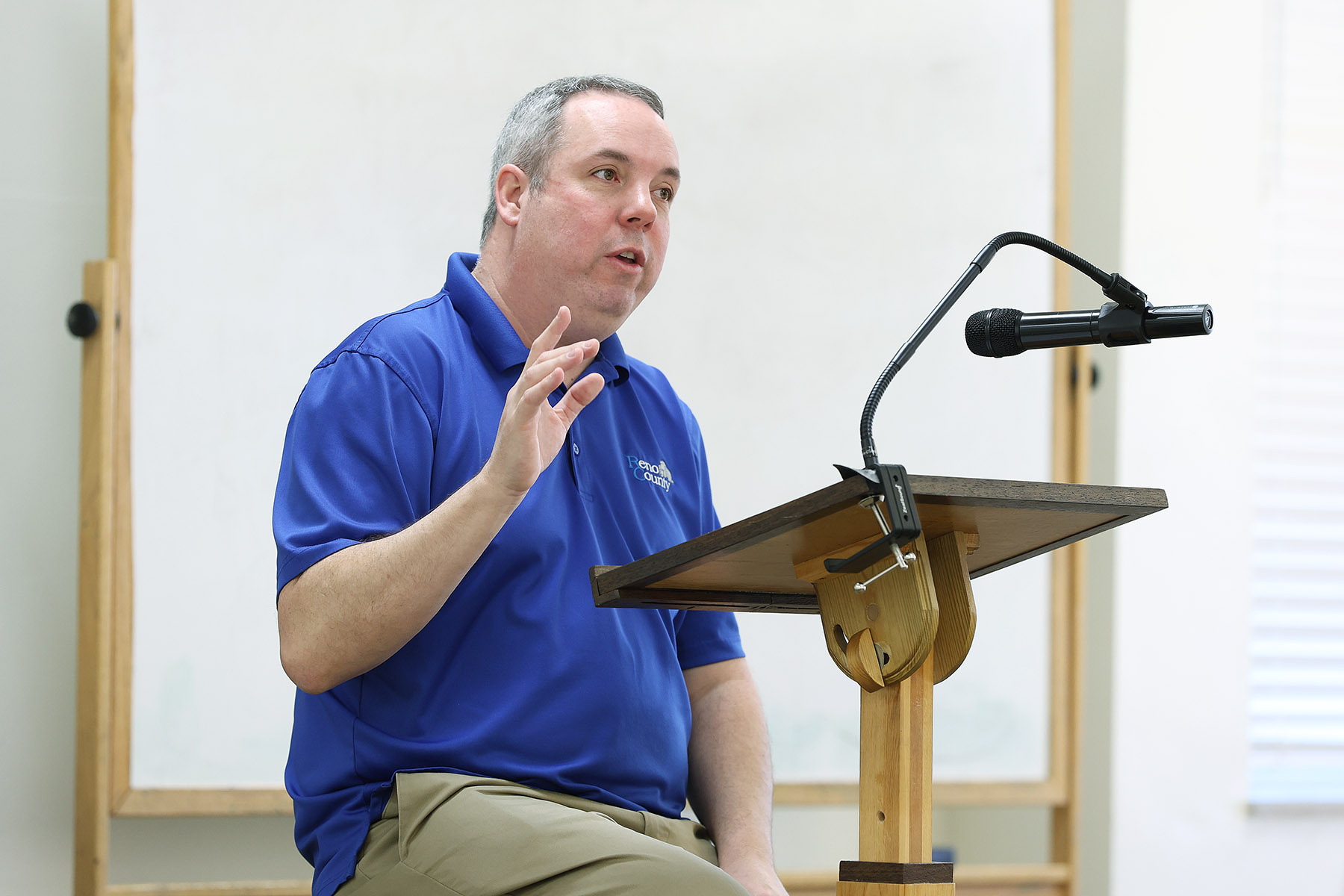
 Reno County Appraiser Michael Plank answers questions during a Town Hall meeting on Saturday morning, Feb. 21, 2026 at Eastwood Church of Christ.
  Reno County Appraiser Michael Plank explains how Kansas property valuations work Saturday morning at Eastwood Church of Christ.
 Reno County Commissioner Ron Vincent, right, encourages people to contact the commission with questions or ideas.
  Reno County Commissioner Richard Winger, second from right, talks to Hutchinson City Counil member Darrin Truan, right.
Reno County Appraiser Michael Plank hosted an educational town hall to explain how Kansas property valuation works and how those valuations connect to property taxes. He emphasized that the Appraiser’s Office is responsible—by state law—for classification and fair market valuation as of January 1 each year, using mass appraisal standards (USPAP) and verified sales data. He repeatedly clarified what the office does not do: set budgets, set mill levies, or raise taxes—those decisions are made by elected taxing authorities. Plank walked attendees through the three accepted appraisal approaches (sales comparison, cost, and income), described how Reno County uses the Orion system to apply consistent methodology across parcels, and explained the annual cycle (valuation → notices → appeals → certification → budgets/mills → tax statements). He also reviewed how tax dollars are distributed among jurisdictions (county, city, schools, community college, etc.), shared local trends showing strong sales-price growth since 2019, and outlined what makes a sale “valid” for valuation modeling.
During Q&A, attendees asked about state compliance standards, how often properties are physically inspected (including use of aerial imagery/drive-bys for safety and practicality), how the appeal process works and what evidence helps, and why values can jump sharply. Plank advised that successful appeals focus on one question—what the property could have sold for on January 1—and warned that bringing up taxes or percent increases at higher-level hearings can undermine a case. He noted that last year the office handled roughly 500 appeals out of about 36,000 parcels, with values adjusted in about 40% of appealed cases (ballpark figures given at the meeting). He also explained that ag land is valued differently (using a state formula), discussed the office’s legal authority to inspect exteriors (while not entering homes without invitation), and highlighted recent changes such as certain personal property exemptions shifting more burden toward real estate. Commissioner Ron Vincent and Commissioner Richard Winger were present; Vincent closed by encouraging residents to share ideas, noting the county’s limits under state regulation, and reinforcing that commissioners’ main lever is budgeting and the mill levy.
 Reno County Appraiser Michael Plank explains how Kansas property valuations work Saturday morning at Eastwood Church of Christ.
  More than 25 people attended and asked questions at the end of the presentation.
  Reno County Appraiser goes through the appraisal process with people who attended the Town Hall meeting on Saturday, Feb. 21, 2026, at Eastwood Church of Christ.
 More than 25 people attended and asked questions at the end of the presentation.
Key messages
- Purpose of the meeting: education on the Kansas valuation system—not debates, policy arguments, or individual property reviews on-site.
- Appraiser’s role (and limits): the office determines classification + fair market value; it does not set mill levies or budgets.
- Mass appraisal = uniform method, not identical increases: “uniform and equitable” means consistent methodology across parcels, not equal dollar/percent changes.
- Three accepted valuation approaches: sales comparison (most residential), income (commercial income-producing), and cost (new/special-use/limited data).
- Valuation ≠ taxes: property taxes depend on budgets and mill levies set by taxing authorities; appraised value is one part of the formula.
- No speculation: valuations rely on verified market evidence, not Zillow estimates, headlines, or “what might happen” nearby.
- Appeals are about value/classification only: bring evidence (photos, repair bids, appraisals, factual condition issues) and stay focused on market value as of Jan. 1.
- Inspection cadence: parcels are reviewed at least once every six years, using a mix of aerial/drive-by and in-person exterior review when needed.
- Sales trends drive increases: countywide sales-price growth since 2019 was presented as a key reason many values rose in recent years.
- Where taxes go: most of the bill is distributed beyond the county (schools, city, community college, fire/library, etc.), so the county doesn’t keep most of what it collects.
- Elected officials’ lever: commissioners can influence taxes primarily through budgets/mill levy decisions, while valuation is governed by state law and compliance standards.
 Reno County Appraiser Michael Plank answers questions during the Town Hall meeting on Saturday.
 Reno County Appraiser Michael Plank, left, answers questions after the presentation.
 Commissioner Richard Winger, left, talks to City of Hutchinson Council Member Darrin Truan.